For most ecommerce marketing managers, the Q4 dashboard is a sea of red and green that triggers a specific type of anxiety. One they only understand. As the holiday auction heats up, the Cost Per Click (CPC) begins its inevitable climb.
The standard agency playbook? Chasing vanity metrics. When CPCs rise, digital marketing agencies often pull back, cap bids or pivot spend toward cheaper longtail terms to keep cost in control.
After analysing $1,000,000 in peak season spend across the Gifting and Alcohol sectors in 2025, we discovered that this safety first approach is often a recipe for leaving your most profitable revenue on the table.
We found a phenomenon we’re calling the Return On Ad Spend (ROAS) Paradox. In high intent categories, the more expensive the click, the more profitable the outcome.
We categorised search terms into three distinct intent levels:
- High Intent Immediate Action
- Large Volume Intent (Corporate/Bulk Buy)
- Discovery Based Intent
We analysed these categories against account averages to understand how the searcher's mindset affects the cost-to-revenue ratio.
Intent vs volume: Not all clicks are created equal
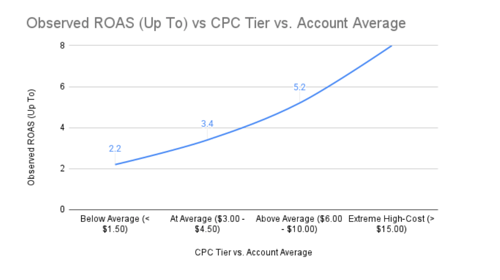
We needed to determine if there were significant differences in ROAS based solely on the ticket price of a search term. Data from November and December 2025 showed that terms with a CPC significantly above the account average often provided the best returns.
Despite increasing costs, these terms greatly enhanced the Conversion Rate (CR) and Average Order Value (AOV), making them the most profitable parts of the account.
We categorised the 2025 auction into three distinct Intent Tiers.
Tier 1: The discovery based intent trap
This tier represents the Top of Funnel broad ecommerce traffic. While the average CPC in 2025 sat around $5.26, the ROAS was often disappointing.
- The intent: Users searching for "gift ideas," "guides," or "best ways to thank someone."
- The problem: These are window shoppers. In 2025, we saw a massive shift. 98% of these visitors don't convert on the first click.
Additionally, a significant portion of this informational traffic is now shifting towards AI search platforms. This is making traditional Search Ads in this tier increasingly inefficient for direct response.
Tier 2: High intent immediate action
- The intent: This is the sweet spot for holiday gifting. This is often the most efficient range for holiday gifting. Search terms in this category are defined by transactional verbs and logistics-based modifiers like "delivery," "order," "same day," and "buy". These users have typically completed their exploration phase and are seeking a platform to finalise their transaction.
In the Gifting’s account data, these terms showed the highest potential for immediate ROAS.
-
The result: Because the consumer is in a position of high need and low price sensitivity, conversion rates jumped to 8% to 14%. This surge in conversion outpaced the rise in CPC, leading to a higher ROAS than the cheaper tier.
Tier 3: The corporate whale
This is where the ROAS Paradox is most extreme. The Large Volume category includes B2B queries where users are searching for group solutions rather than individual ones. This includes terms like "corporate gift ideas," "bulk christmas gifts," and "gifts for my team".
Despite clicks being 4x to 6x more expensive than average, the Average Order Value (AOV) for bulk orders was 5x to 10x higher, yielding the maximum possible return on the account.
- The intent: "Corporate gift ideas for clients”, "bulk Christmas gifts for staff," or "wine cases for remote teams."
The result: While a $30 click might make a media buyer flinch, the AOV for these orders in 2025 often exceeded $4,000. When you are paying 6x the average CPC but receiving 10x the average AOV, you aren't just buying a click. You're buying a high margin business contract.
Comparing performance data by tier
The table below summarises our 2025 account performance data, showing how the intensity of the searcher's mindset affects the cost to revenue ratio.
| CPC tier | Search intent context | Avg. Order Value (AOV) | Observed ROAS | |
| Low (< $10) | General research, broad gift ideas, and Shopping ads | $50 – $120 | 2.5x – 3.5x | -60% CTR / ROAS |
| Mid ($10 - $20) | High urgency ("delivery today") and premium brand names | $150 – $300 | 3.5x – 5.5x | +40% Conversion Rate |
| High ($20 - $30+) | Corporate bulk orders, B2B gifts, and employee gifting | $500+ | $500+ | +150% Average Order Value |
The takeaway: As CPC increases, the quality of intent increases at a faster rate. The Extreme tier consists mainly of corporate bulk orders and luxury brand customers who avoid the deal-seeking behavior typical of the cheap tier.
Why this happens in peak season
To understand why this dynamic occurs, we also took a look at consumer psychology and auction mechanics simultaneously.
High CPC search terms generally represent strong commercial intent. These are users who are at the very bottom of the marketing funnel. They are not searching for "best running shoes reviews"; they are searching for "buy Nike Vaporfly size 10 express delivery."
Every advertiser’s algorithm recognises value when a user executes a search query with specific, urgent intent. The Smart Bidding systems (like Target ROAS or Maximise Conversion Value) react instantly. They bid aggressively because the probability of a sale is incredibly high. When every competitor bids aggressively for the same high value user, the CPC naturally spikes.
The high price is a signal that you are competing for a target audience that is about to spend money.
Lower CPC terms, on the other hand, often capture early stage or exploratory intent. These are broader, less defined searches. These people might be looking for inspiration, comparing features, or simply window shopping without intending to buy until January.
Because these users have a much lower conversion rate, sophisticated advertisers bid less for them. The competition is lower, so the price drops. You can cheaply acquire thousands of these clicks, but that "cheap" traffic becomes wasted budget if they don't convert.
Suppressing high intent traffic during peak demand often causes more damage than paying a higher price per click.
The real risk of CPC caps
Online advertising relies heavily on machine learning. Google’s Smart Bidding algorithms analyse millions of signals to predict conversion likelihood. These include time of day, device type and browsing history.
When you set a target (like ROAS), you are giving the algorithm a goal. When you set a bid cap (CPC limit), you are giving it a restriction.
Capping a bid effectively instructs the algorithm to ignore your best customers. This forces the system to hunt for cheap users who are likely doing little more than window shopping.
Imagine you are fishing. You know the biggest, most prized tuna swim in deep, difficult waters that require expensive equipment to reach. The shallow waters are full of minnows and old boots, but it is cheap to cast a line there.
A bid cap effectively bans your boat from the deep water. You are forcing your captain to fish in the shallows. You might catch more "fish" (clicks), but you will not have much to sell at the market (revenue).
If we had implemented the proposed caps, we would have:
- Reduced visibility on profitable queries: We would have lost impression share for specific, high intent keywords driving revenue.
- Forced budget into lower quality demand: If caps restrict spending on premium users, the algorithm shifts budget to lower quality traffic to achieve its targets.
- Artificially constrained performance: We would have choked our revenue stream during the most valuable weeks of the year.
In short, we would have protected a cost metric at the expense of revenue. We would have saved pennies on the click to lose dollars on the sale.
A better question to ask is...
Rising CPCs trigger understandable but often misplaced anxiety. It stems from viewing CPC as a "cost" rather than an "investment price."
Marketers and business owners should ask "Which clicks actually make money, even when they cost more?" instead of "How do we stop CPCs from increasing?"
CPC is a pricing signal, not a success metric. It is simply the market rate for a specific interaction. If a customer worth $500 costs $50 to acquire, and a customer worth $0 costs $5, the $50 click is clearly the better deal.
ROAS, conversion value and intent alignment tell the real story. If your ROAS is holding steady or increasing while your CPCs rise, you are in a healthy position. It means you are winning high quality auctions. If your CPCs are rising and your ROAS is crashing, that is when you have an efficiency problem.
When the paradox fails
It is important to note that this is not a one size fits all strategy. When we ran the same analysis for a client in the retail sector, we saw a completely different story.
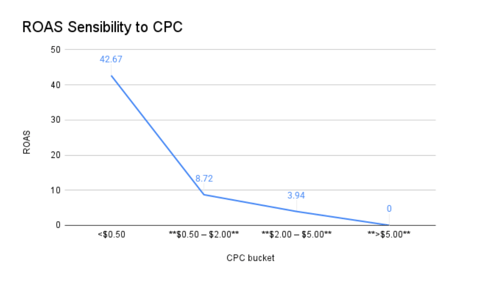
There is a significant performance cliff as search terms become more expensive. Search terms with low CPCs are the primary drivers of account profitability.
| CPC bucket | Spend (AUD) | ROAS | Avg. CPC | Insights |
| <$0.50 | $273.01 | 42.67 | $0.30 | Most efficient. High intent long tail terms |
| $0.50 - $2.00 | $2,263.32 | 8.72 | $1.07 | Core performance range (Stable ROAS) |
| $2.00 - $5.00 | $889.51 | 3.94 | $2.70 | Performance Drop: ROAS halved compared to average |
| >$5.00 | $157.16 | 0.00 | $7.86 | Inefficient: Zero conversions in this period |
The data was segmented into categories based on campaign naming conventions.
- Commercial products: Average CPC of $1.29 with a healthy 8.85 ROAS. This industry segment is slightly more expensive than the average but remains highly profitable.
- Consumer products: More affordable average CPC of $0.77 and a strong 8.12 ROAS. This segment likely benefited from the peak season leading up to Christmas.
- Competitor terms: These are relatively expensive ($0.96 CPC) with a lower 6.14 ROAS, which is expected as competitor traffic typically converts at lower rates.
How to audit your Google Ads account
If you are an ecommerce Marketing Manager, you need to know which side of the Paradox your brand sits on. Ask your Goolge Ads agency these three questions:
- "What is our ROAS breakdown by CPC bucket?" If they aren't segmenting your data this way, they might be over optimising for a blended average. This hides your most profitable segments.
- "Are we excluding Discovery terms that have shifted to AI?" If you're still spending heavily on ideas and guides, you're likely subsidising window shopping.
- "Are we bidding strategies based on Buyer’s Intent?" If your AOV in the Elite CPC tier is high, you should be willing to pay almost any price to own that search result.
We can help identify these hidden high ROAS opportunities. Get a free Google Ads audit to help you find success with your ads.