We can appreciate the art on a billboard and still wish it wasn't blocking the sunset.
Creative production values don't matter. Perfect targeting doesn't matter. If an ad feels aggressive or interrupts a moment of flow - it immediately triggers a defence mechanism.It doesn’t matter if the creative is beautifully produced. It doesn't matter if the targeting is perfect and I actually need the product. If an ad feels aggressive and too in-my-face - if it screams "RUN DON'T WALK" or interrupts a moment of flow - it immediately triggers a defence mechanism.
And right now? That mechanism is working overtime.
It feels like we have reached a point of total marketing saturation. In the industry, we call this ad fatigue, but to the average person, it just feels like noise.
Digital billboards outshine streetlights. Ad breaks blast louder than the volume of the song just before it. True crime podcasts segue awkwardly into cheerful banking promos. Friends post bedside table photos where affiliate links tag every single item.
It’s frustrating because we know that marketing can be done differently through storytelling, connection, and genuine value, without the manufactured urgency or FOMO.
But now those moments are buried under the noise.
Walking down the street or scrolling a feed feels like walking through a minefield. Brands constantly prospect, track, and pitch us.
So, whenever possible, users move past it. Fast.
This feels like a small act of rebellion. A way to say: “You don’t own my attention.”
This reaction might sound irrational or over-the-top, but as I spend more and more of my life on the internet, I’m realising that it’s actually deeply scientific.
I spent my university years studying Cognitive Science and the intersection between Human and Artificial Intelligence. I was taught to look at screens not just as pixels, but as psychological environments. From that perspective, 'ad fatigue' is actually a predictable response rooted in consumer behaviour psychology.
You’d think this would make me the perfect target audience, or at least an appreciative observer of the craft. Instead, it has made me the most resistant user of all.
I am the first person to reach for the remote to mute the TV during a commercial break that interrupts my show. I drop what I’m doing to reach for my phone and fast-forward through the sponsor segments of my favourite podcast. And when a friend on Instagram posts a generic #partner story about the latest "essential" supplement, I skip past with a tinge of guilt.
I love supporting creators, and I understand the economics of the internet. But I hate feeling like I’m paying "rent" with my attention just to view their content, especially when that rent is paid in meaningless mind-clutter.
What my background has taught me is this: that feeling of "spite" isn't a bug in the human brain. It’s a feature. It is a predictable, documented neurological response.
The psychology of "spite" (Why we rebel)
You might look at this behaviour - the quick scroll past, the muting, the skipping - and dismiss it as impatience or a short attention span.
Though it might play a part in it, if we look at it through a psychological lens, something deeper is happening.
When a loud, aggressive ad interrupts your flow, your brain doesn't just register annoyance; it registers a threat. That feeling of "spite" isn't a personality flaw. It is a biological defense mechanism designed to protect your autonomy and preserve your energy.
Here are the two principles that explain why we revolt.
Psychological Reactance: The "you can't make me" reflex
In psychology, there is a concept called Reactance Theory. It suggests that when humans feel their freedom of choice is threatened or eliminated, they instinctively push back to regain a sense of agency.
Think about the engineered copy we see every day: “Run Don’t Walk!”, “Last Chance!”, “You NEED this!”
To a marketer, this is just a Call to Action. But to the human brain, this is a command that feels like a restriction of freedom to dictate your behavior, and your brain’s immediate counter-move might be to assert dominance.
That "spite skip" is Reactance in action.
When an unskippable video forces us to watch 15 seconds of content we didn't ask for, the brain isn't absorbing the brand message. Instead of building desire, the forced wait builds a wall. The brand fails to make an impression; it simply delays the content the user actually wants.
This isn't necessarily the brand’s fault. We live in a world where ads fill every free space, digital or physical.
2. Banner Blindness: Why our brains delete ads
But what about the ads that aren't aggressive? The static banners on the side of a webpage, or the polished graphics in a feed?
Even when we aren't actively skipping them, our brains are actively deleting them. This behaviour is often called Banner Blindness, but you can think of it as evolutionary efficiency.
Our brains are expensive machines to run. To conserve energy, they evolved to filter out irrelevant patterns, like swaying grass, so we could focus on what mattered: threats (a predator) or opportunities (food).
Online, specific patterns trigger this same filter. It’s the 'Sponsored' tag in the corner. It’s the image that looks far too polished and posed to be from a friend. It’s the high-contrast button begging to be clicked.
These are the modern equivalent of swaying grass - background noise that we feel offers no value, so we scroll right past.
If you look at eye-tracking heatmaps of users browsing websites, you will likely notice a pattern. Users will read the content they came for, while the ad spaces remain cold.
We don't just choose to ignore these ads; often times we literally do not see them. Our brains classify the content as "junk data" and filter it out before it even reaches conscious perception.
So, we have a brain that aggressively fights back against loud ads (Reactance) and completely erases quiet ones (Banner Blindness).
This makes the job of a marketer incredibly difficult. But it gets even more complicated when the person selling to us isn't a faceless brand, but a friend.
The "trust transfer" & the influencer betrayal
We expect billboards to treat us like customers. We don't expect friends to treat us like leads. When that line blurs, the interaction stops feeling relational and starts feeling transactional.
The Friend vs. The Salesman
In marketing psychology, this relies on something called Trust Transfer Theory.
The logic is simple: Humans are wired to trust "people like us" (our circle) more than faceless institutions. When an influencer or a friend recommends a product, they are lending their Source Credibility to the brand. The brand hopes that because I trust you, I will automatically trust the thing you are holding.
For a long time, this worked. It’s why Influencer Marketing became a billion-dollar industry. We listen to people, not logos.
But this is a fragile currency.
When a trusted creator suddenly pivots to sharing a “life changing” lip gloss, a generic powdered supplement, or clutter in a shiny disguise, it triggers Cognitive Dissonance.
To be clear, this doesn't apply to the creators who genuinely vet their partnerships. When a friend shares a brand deal they actually love and use, the system works. I want to know what you’re loving.
Audiences today are hyper-aware. They distinguish between genuine recommendations and posts made to secure a PR box.
The brain struggles to reconcile two conflicting realities:
- "This person is a trusted source."
- "This person is reading a script to sell me something."
The brain hates ambiguity. It resolves the conflict by downgrading the source. Trust does not transfer to the brand; distrust transfers to the creator.
This explains the guilt users feel when skipping a friend's story.
They want to see life updates or art. They are not willing to watch a friend become a human billboard. This is the core problem with modern influencer authenticity. When the 'Trust Transfer' feels transactional, users scroll past the ad, and the connection weakens.
So, if the brain aggressively fights strangers (Reactance) and feels betrayed by friends (Cognitive Dissonance), is there any way to actually reach people?
Yes. But we have to stop shouting, and we have to start connecting.
The Antidote (Connection over conversion)
If we automatically filter out the loud stuff (Banner Blindness) and feel betrayed by the fake stuff (Trust Transfer failure), what is left? What actually makes it through the filter?
This brings us back to the heart of it all - storytelling.
But not "storytelling" in the marketing buzzword sense where a brand shares about how their toaster will change the world - the cognitive mechanism known as Neural Coupling.
Syncing the brain (Why stories don't trigger spite)
In a captivating TED Talk, Princeton neuroscientist Uri Hasson shares his research on exactly why this works. He found that when a person tells a vivid story and another person listens, their brains actually start to synchronise.
The listener’s brain activity mirrors the speaker’s, not just in the language processing centres, but in the areas responsible for emotion and sensory experience.
This is the antidote to Reactance.
When an ad screams "RUN DON'T WALK," the brain registers a command and puts up a wall. But when a piece of content tells a real narrative with conflict, context, and resolution, the brain drops the wall to let the story in.
This bypasses defence mechanisms. You are not commanding action; you are inviting emotion.
Successful ads respect this. They don't scream "MUST-HAVE ESSENTIALS." They simply reveal, "We’re all human and we understand where you are."
It’s not the influencer holding the bottle to the camera with a frozen smile. It’s the video of a chaotic morning routine where the product is just a quiet, helpful tool that gets them out the door. It’s not the car commercial shouting about APR financing; it’s the quiet visual of a dad driving his sleeping kid around the block just to get ten minutes of peace.
The goal isn't to shout louder to be heard over the noise. The goal is to lower the defensive walls so you don't have to shout.
But how do you do that visually, especially if you don't have a Super Bowl budget? You have to learn how to disrupt the feed without disrupting the user.
How to stand out (Visual storytelling that stops the scroll)
You don't need a million-dollar production team to stop the scroll. You just need to respect the biology of the eye.
The Von Restorff Effect (The Pattern Interrupt)
There is a cognitive bias known as the Von Restorff Effect (or The Isolation Effect). It states that when multiple similar objects are present, the one that differs from the rest is most likely to be remembered.
If you put a red tomato in a basket of green apples, your eye doesn't choose to look at the tomato. It is biologically forced to look at it.
For the last decade, the "Green Apple" of social media has been high-gloss perfection. Studio lighting. Saturated colours.
So, to stand out, you have to do the opposite.
In a feed of polished, fake perfection, a raw, grainy phone photo feels "real." It signals safety to the brain because it looks like something a friend posted, not something a brand paid for.

Credit: Apple
Apple’s 'Shot on iPhone' campaign is the perfect case study for the Von Restorff Effect. They have the largest marketing budget in the world, yet they choose to display grainy, candid, and often imperfect photos on massive billboards.
Why? Because it evokes emotion. It doesn't look like an ad; it looks like a memory. By stripping away the studio polish, it feels more authentically human, not corporately manufactured, allowing it to slip past our marketing defence mechanisms.
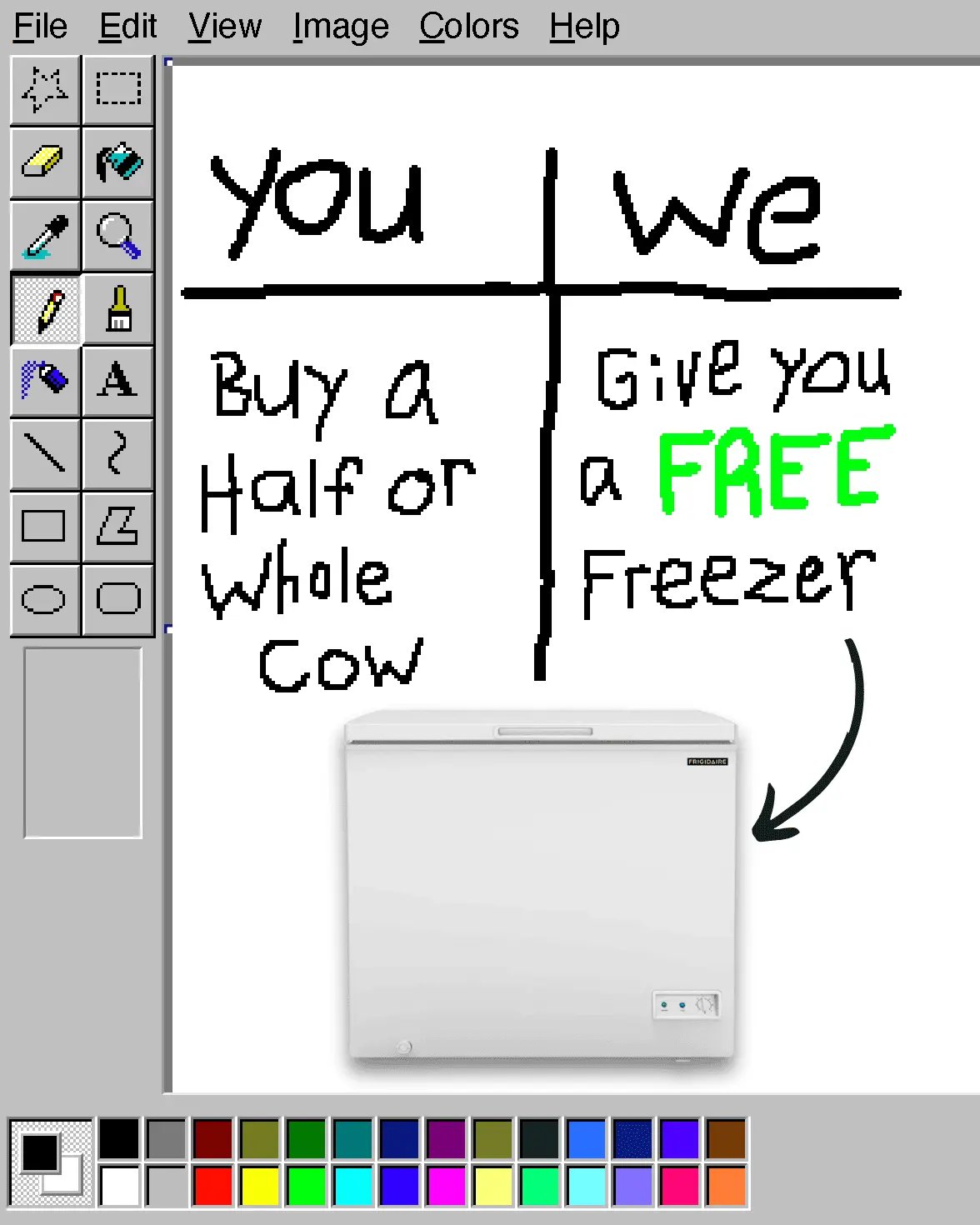
Credit: Dirty Dog Farm
This ad looks like it was made in MS Paint in 1998. And that is exactly why it stops the scroll.
In a feed dominated by perfectly kerned fonts and 'Corporate Blue' palettes, this chaotic aesthetic acts as a massive Pattern Interrupt. It signals to the brain: 'This isn't a polished brand trying to trick you; this is a real person making you an offer.'
It disarms our resistance by being aggressively unpolished. It forces the brain to engage with the content ('Is this a meme? Is this real?') rather than instantly filtering it out as ad noise.
Static storytelling (The "In Media Res" technique)
There is a misconception that you need video to tell a story. You don't. You just need to know how to frame a scene.
The most effective static ads use a technique called In Media Res (Latin for "in the midst of things"). Instead of showing the product in a sterile studio box, show it in the middle of real life. Show the evidence that the product works, rather than the product itself.
This campaign from loveholidays is a masterclass in “Show, Don't Tell.”
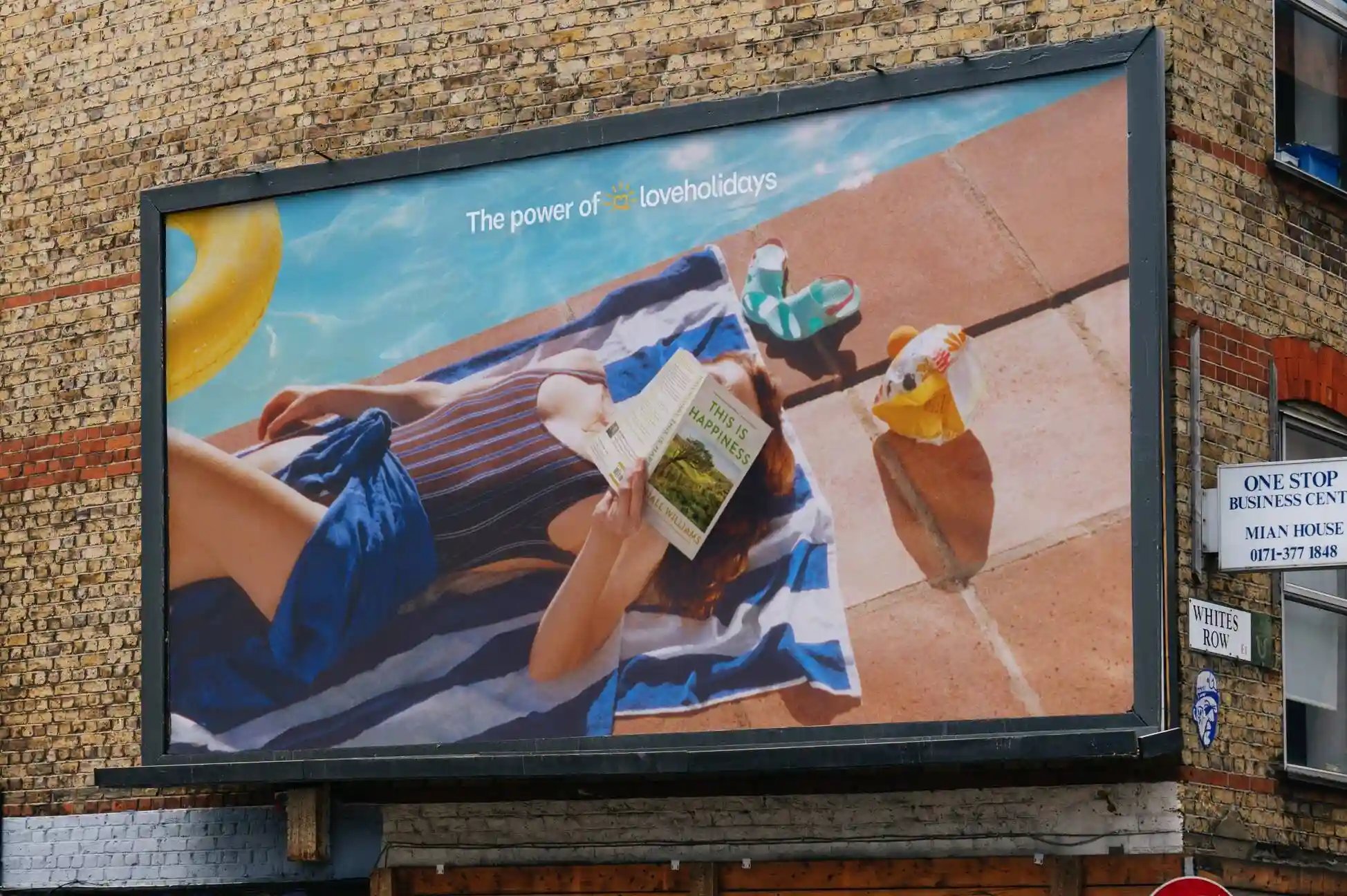
Credit: loveholidays
Instead of cluttering the billboard with flight prices, discount codes, or a screaming 'BOOK NOW' button, they simply frame the moment we all crave: the silence of the poolside.
By using the book title (This is Happiness) as the primary message, they allow the viewer's brain to do the work. We instantly project ourselves into that deck chair. We can feel the sun and smell the chlorine. It bypasses our sales resistance because it isn't selling a transaction; it’s selling a feeling.
Here are more ways you can tell stories through your creative:
- Don't show the perfectly plated pasta dish. Capture the aftermath of a night well spent - empty plates, crumpled napkins, wine stains, and satisfied posture.
- Don't show the pristine white sneakers in a box. Show them muddy and kicked off by the front door after a personal best run.
- Don't show the real estate agent’s headshot. Show the pizza box on the floor of an empty living room on move-in night.
- Don't show the diamond ring in a velvet box. Show the wrinkled hand holding it after 50 years of marriage.
- Don't show the lawnmower. Show the dad drinking a beer while looking at a perfect stripe of green grass.
You can apply this same principle to copywriting and graphics. Don't describe the feature; show the moment the problem is solved.
- Selling noise-canceling headphones: Don't just list features. Write: "The baby in 14B is screaming. You are listening to rainfall in a Kyoto garden."
- Selling tax software: Don't promise speed. Write: "It’s April 14th. You’re watching Netflix."
- Selling productivity tools: Don't design a dashboard. Illustrate a calendar that is completely blank after 3 PM on a Friday.
Why does this work? Because the human brain is an inference machine.
When we see the "aftermath" or read the snapshot, our brains automatically fill in the gaps. We participate in the ad rather than just viewing it.
By inviting the user to complete the story, you turn a passive impression into an active engagement. You haven't shouted at them; you've let them in.
Reclaiming the View
As marketers, we have the privilege of entering the user's brain. But in an attention economy that rewards volume, it’s easy to forget that attention is a gift to be earned, not a resource to be extracted.
The "spite skip" isn't a rejection of discovery. Humans love discovering new things. We just hate interruptions.
The solution isn't to stop marketing; it's to start marketing with more empathy. We have to move away from the "Run Don't Walk" panic and toward the shared connection of a good story. We have to stop designing for "users" (clicks) and start designing for humans.
We can still build billboards. But we have to accept that if we want to be truly seen, we can no longer afford to be in the way.
Get in touch and let’s talk about how we can help you craft scroll-stopping content.